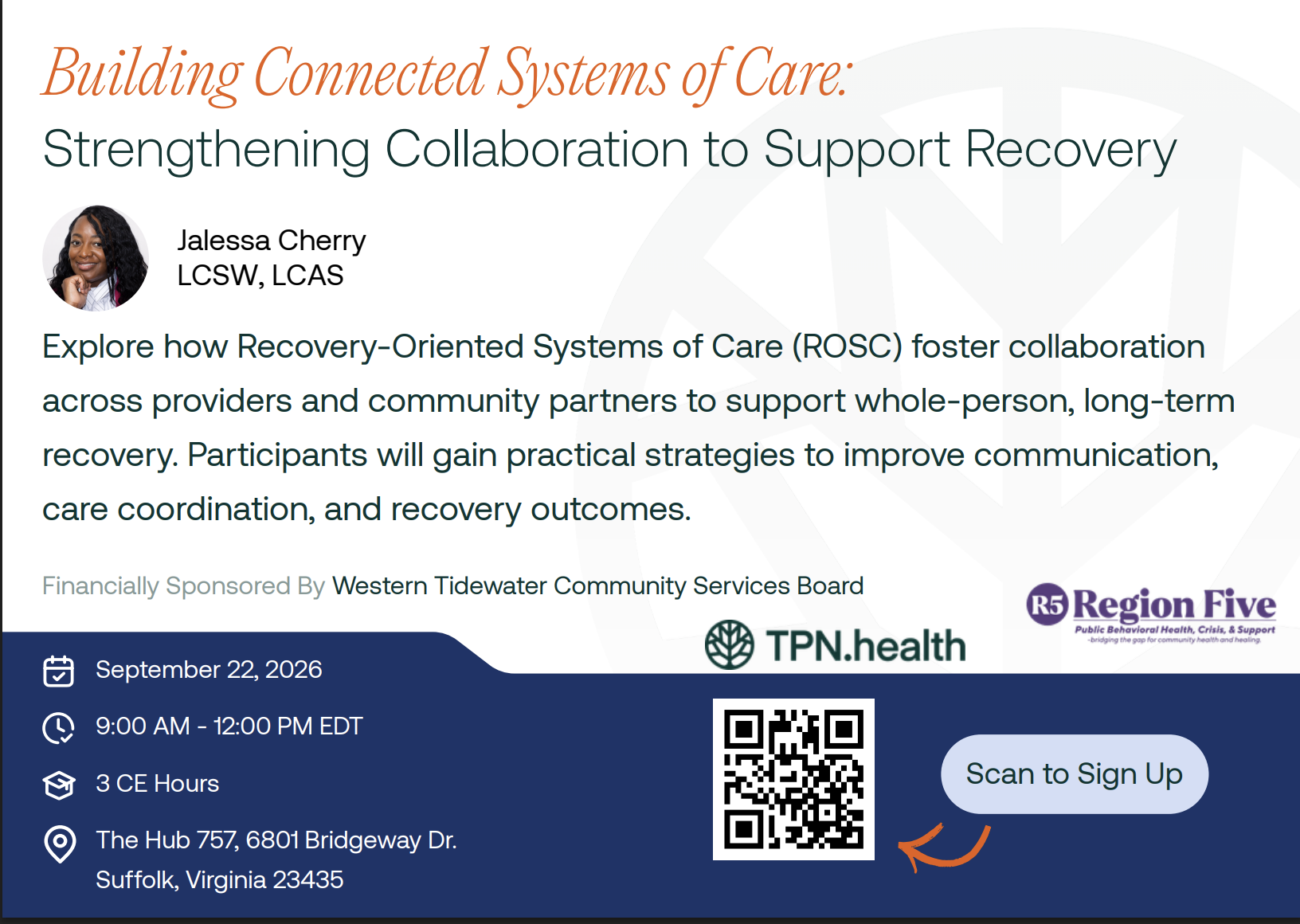
Building Connected Systems of Care: Strengthening Collaboration to Support Recovery
CEUs available!
Recovery is built through relationships—but sustained through connected systems. As substance use treatment continues to evolve toward person-centered, recovery-oriented care, effective collaboration across healthcare, behavioral health, social services, and community organizations has never been more essential.
This interactive workshop explores how Recovery-Oriented Systems of Care (ROSC) provide the foundation for coordinated, community-based support that promotes long-term recovery. Through realistic case scenarios, facilitated discussion, and practical application, participants will examine the complementary roles of providers, peer support specialists, care coordinators, and community partners in creating integrated systems that address the whole-person needs of individuals with substance use disorders.
Participants will identify common barriers to collaboration, explore strategies for strengthening communication and care transitions, and develop person-centered approaches that leverage community resources, interdisciplinary partnerships, and recovery supports. Designed for behavioral health professionals, healthcare providers, peer support specialists, social workers, case managers, and community partners, this workshop equips attendees with practical tools to move beyond fragmented services and build connected systems that improve engagement, continuity of care, and recovery outcomes.
Date: September 22nd, 2026
Time: 9:00AM – 12:00PM
Location: The Hub 757, 6801 Bridgeway Dr.
Suffolk, Virginia 23435
Learning Objectives
Participants will be able to
- • Explain at least three core principles of Recovery-Oriented Systems of Care (ROSC) and the role of connected systems in supporting long-term recovery for individuals with substance use disorders.
- • Differentiate at least five distinct roles and responsibilities of healthcare providers, behavioral health professionals, peer support specialists, social service agencies, and community partners in creating an integrated system of care.
- • Apply at least three communication and collaboration strategies to strengthen partnerships, improve care transitions, and promote continuity of care across healthcare, behavioral health, and community-based settings.
- • Analyze at least three distinct barriers to coordinated care and develop at least two practical strategies to reduce fragmentation, strengthen cross-sector collaboration, and improve recovery outcomes.Design one person-centered, community-informed approach to care coordination that integrates recovery supports, interdisciplinary partnerships, and community resources to address whole-person needs.
Educational Goal
The educational goal of this workshop is to gain practical strategies for building connected systems of care that strengthen collaboration across healthcare, behavioral health, and community organizations. Through the framework of Recovery-Oriented Systems of Care (ROSC), attendees will learn how person-centered, coordinated approaches improve engagement, continuity of care, and long-term recovery outcomes.
Target Audience
- • Addiction Professional
- • Counselor
- • Marriage & Family Therapist
- • Nurse
- • Physician
- • Psychologist
- • Social Worker
Trainer: Jalessa Cherry, LCSW, LCAS
Jalessa Cherry, LCSW, LCAS, is a dual-licensed clinical social worker and addiction counselor with over eight years of experience in the field. She possesses extensive expertise in providing clinical training and supervision to mental health and addiction treatment professionals. Jalessa is trained in several evidence-based treatment modalities, including EMDR, CBT, and behavioral activation, and she is also certified as a clinical treatment provider for ADHD. Additionally, with more than nine years of instructional experience, she holds a Master’s degree from East Carolina University, as well as certificates in Gerontology and Military Trauma & Counseling. Her diverse professional background includes roles in inpatient psychiatric settings, mobile crisis intervention, behavioral health primary care, and outpatient mental health and substance use treatment. In January 2024, Jalessa had the privilege of presenting “Comprehensive Clinical Assessments with a Focus on Quality” at the NAADAC conference. She also presented at the Eastern NC AHEC 2024 Substance Use Conference on “Trauma-Informed Approaches for Working with Military Personnel and Veterans with Substance Use Disorder.